Iron fitting: what actually happens
Ninety minutes, one golfer, 120-plus swings. Here’s exactly what an iron fitting looks like with us, checked club by club, and why we MOI match every set, the step most fitters skip.
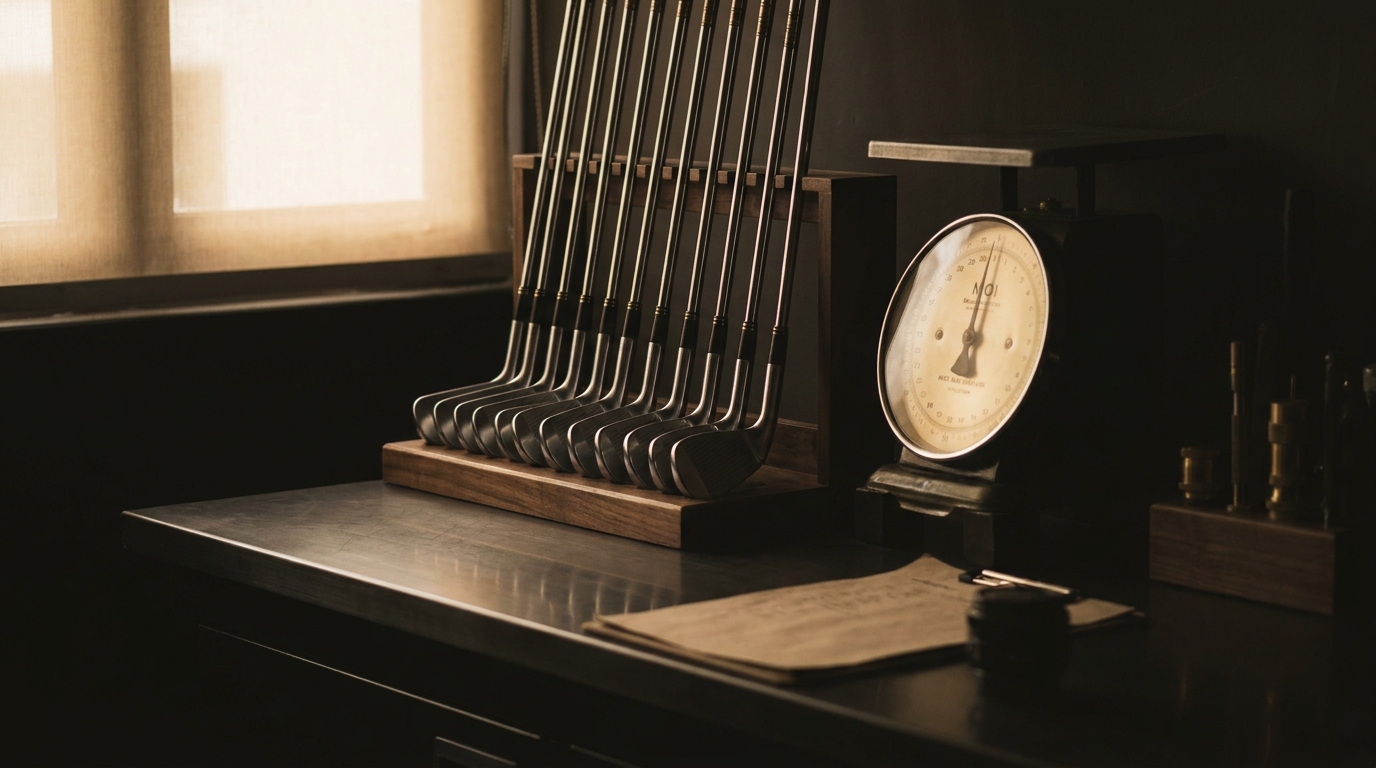
People picture an iron fitting as a salesman handing you clubs to try until one feels nice. It isn’t that. It’s ninety minutes of measuring, one change at a time, until your numbers on the launch monitor say the set is right for the swing you actually have.
Here’s the whole thing, start to finish, so you know exactly what you’re booking.
The 90-minute session, step by step
Every fitting is one golfer at a time, by appointment, run start to finish by Ian. It never gets handed to a junior, and no one else is hitting balls next to you. Here’s how the time goes.
- We measure your own irons first. You warm up and hit the clubs you walked in with, on the launch monitor, so we have a true baseline. Ball speed, launch, spin, and the real dispersion, not a guess and not a feel.
- We change one thing at a time. Shaft, then length, then lie, then head, testing each against the numbers before moving on. Change five things at once and you learn nothing; change one and the screen tells you whether it helped.
- You hit a lot of balls. A typical iron fitting is 120-plus swings. One good shot proves nothing. A pattern proves everything, so we keep going until the numbers settle into something repeatable.
- You feel it before you commit. You hit the fitted spec yourself and watch the change on screen. Nothing goes on the build sheet that you haven’t already seen work in your own hands.
- We write it down. You leave with the exact spec, every number, whether you build the set with us or not.
What we check on every iron
An iron fitting isn’t one measurement, it’s a stack of them, and each one changes how the ball comes off the face. These are the pieces we work through:
- Head. How forgiving it is, how it launches, how it turns over. The right head suits your speed and your miss, not the one on the shop wall this month.
- Shaft. Weight, flex and profile. A shaft that’s too stiff, too soft or the wrong weight changes launch, spin and timing on its own, before you touch anything else.
- Length. Too long or too short and you move the strike off centre and shift your posture. We match length to your build and how you deliver the club.
- Lie. A lie a couple of degrees off points the face left or right at impact, so the ball starts offline on a flawless swing. We check it under real strikes, not on a static jig.
- Loft and gapping. We look at the distance between each iron so you don’t have two clubs that go the same yardage and a big hole somewhere else in the set.
- Grip. Size and build-up. Too thin or too thick quietly changes how your hands release, which shows up as a pull or a push you’ve been blaming on your swing.
Sort these and your real swing shows up cleanly. Leave them wrong and you spend months grooving compensations for a problem the club created.
Are your irons holding you back?
Why MOI matching is included
This is the part most fittings skip, and it makes the biggest difference to how a set feels.
Most iron sets are only swing-weight matched. Swing weight is a rough balance measure, and matching it still leaves every iron feeling slightly different in your hands. MOI matching goes further. MOI is moment of inertia, the effort a club takes to swing, and we tune each iron so the whole set takes the same effort, top to bottom.
What that does for you is simple. When every iron swings the same, you stop making a slightly different move for each club. The set starts to feel like one club in different lengths, and your timing and strike hold steadier from the wedges up through the long irons. Many players tell us the long irons stop feeling like a separate, scarier bag.
We MOI match every iron set we fit, at no extra charge on top of the fitting. It’s a build-bench job, not a range job, which is exactly why an off-the-rack set never has it done.
Swing-weight matched means the irons are roughly balanced. MOI matched means they all take the same effort to swing. One is a starting point; the other is what makes a set feel like yours.
Do you need new irons?
Usually not, and we’ll tell you so, which surprises people who expect a fitting to end with a sales sheet.
Most sets can be dialled in using the irons you already own. Correct the lie and length, tune the gapping, MOI match the set, and a bag you’d half given up on often comes back to life. We only suggest new heads when the ones you’ve got genuinely can’t reach the numbers your swing is asking for.
We can say that honestly because we’re independent. We’re not tied to a brand, we don’t carry a shop full of stock we need to move, and we fit across makes. The recommendation follows your numbers, not a target on someone’s sales board. If your set is fine, the honest answer is that your set is fine.
What it costs
Clear numbers, published up front. An iron fitting is SGD 150 for the 90-minute session, and MOI matching is included in that, not an extra.
| Session | Time | Price |
|---|---|---|
| Swing & equipment analysis | 30 min | SGD 50 |
| Irons fitting (MOI matched) | 90 min | SGD 150 |
| Gapping, reshaft, regrip, lie/loft… | Varies | Quoted per job |
If you’re not sure it’s worth it yet, start smaller. The SGD 50 swing and equipment analysis reads your swing and your current irons on the launch monitor in 30 minutes and tells you honestly whether the gear is holding you back.
Ready to sort your irons? Ninety minutes, one bay, MOI matched.
Book an iron fitting- 90 minutes, one golfer, 120-plus swings on the launch monitor.
- We check head, shaft, length, lie, loft, gapping and grip, one change at a time.
- MOI matching is included, so the whole set takes the same effort to swing.
- New irons are usually not needed, we fit the set you own where we can.
- SGD 150 for the session.
Want the wider picture on fitting before you book, what it is, what it fixes, what it costs across the board? Read our complete guide to golf club fitting in Singapore.
Common questions
What happens in an iron fitting?
Do I need to buy new irons?
What is MOI matching?
How long does it take?
How much does an iron fitting cost?

Ian, Precision Golf SG
Ian is a golf professional and club fitter. He runs every iron session start to finish, and MOI matches every set he builds. Meet the fitter.