MOI matching, explained plainly.
You’ve maybe seen the term and nodded along. Here’s what MOI matching actually is, in plain English, and how to tell whether it would do anything for your game.
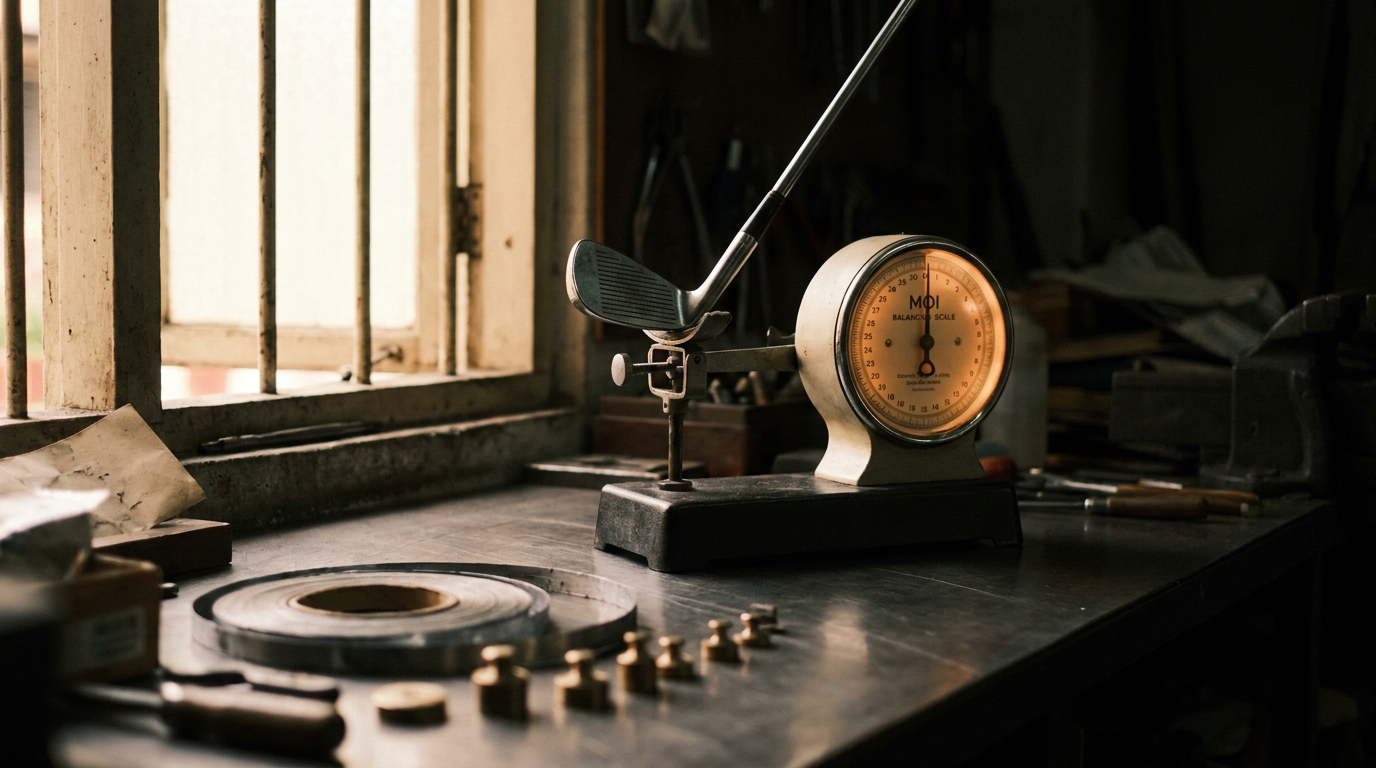
You bought a matched set. Same brand, same look, numbers on the soles in order. So why does the 4-iron feel like a fence post while the 9-iron feels like a toy? That gap has a name, and so does the fix. The fix is MOI matching.
This is the plain-English version. The physics, the scale we use and the workshop detail all live on our MOI matching service page. Here we answer the two questions that matter: what is it, and would it help you?
What MOI matching is
MOI stands for moment of inertia. Ignore the physics-class name, because in practice it means one thing: how much effort it takes to swing the club.
Here’s the everyday version. Hold a broom at the very end and wave it, then slide your hand halfway up and wave it again. Same broom, same weight, completely different effort, because the weight now sits in a different place relative to your hands. Clubs are the same. Two irons can read identical on a kitchen scale and still take different effort to swing.
MOI matching tunes every iron so they all take the same effort to swing. Then you can groove one swing for the whole bag, instead of quietly making a different one per club without realising.
MOI vs swingweight, the old measure
If you’ve heard a fitter say “this set is D2,” that’s swingweight, the measure MOI is quietly replacing.
Swingweight balances a club, sitting still, on a small scale and gives a letter-and-number reading like C9 or D2. It’s been the club-builder’s only number for about a hundred years. The trouble: it tells you how a club feels when it isn’t moving, and a real swing isn’t sitting still.
So two irons can read the same swingweight yet take noticeably different effort to swing. MOI measures the effort in motion, the part your hands feel. That’s the whole difference: swingweight reads the club at rest, MOI reads it in the swing.
Swingweight isn’t wrong, just older and blunter. Some players prefer its traditional “heft” feedback, which is why we still offer a standalone swing weight service. MOI is just the more precise tool for making a whole set feel the same.
What an MOI-matched set feels like
The clearest sign you’ve never played a matched set is that you have a favourite iron. Most golfers do: one club that just feels right, and a couple that feel like strangers. That’s not fussiness. That’s the set being uneven.
When every iron takes the same effort, the favourite stops being special, because none of the others feel like strangers. A few things follow:
- One tempo for the whole set. You stop instinctively slowing down for the long irons and rushing the short ones. Same rhythm, every club.
- Cleaner contact. With the effort sorted, your attention returns to the middle of the face, and many players find their strike tidies up.
- Tighter misses. The little compensations you made club by club stop being needed, so shots bunch closer together.
None of that changes your swing. It changes what your swing has to cope with.
Who needs it, and who won’t notice
MOI matching isn’t for everyone, and we’d rather say so.
It helps most if your swing is fairly repeatable and you can name the symptoms: a favourite iron and one or two you avoid, long irons that feel heavier than the short ones, or a set that looks matched on paper but plays lumpy. Mixed sets built up over the years are prime candidates, so are sets that have had shafts or grips swapped.
You probably won’t notice it yet if you’re a genuine beginner. While your swing is still changing week to week, the gaps between clubs are buried under the bigger changes in your own motion. Get the swing repeatable first, then come back. And if you already love how your set feels, there’s nothing here to fix.
Would MOI matching help you?
A checklist is a hint, not a diagnosis. Measuring your set on the scale is the only way to see the actual spread, and a 30-minute analysis will do exactly that.
It’s done to the irons you already own
Here’s the part people are most surprised by: MOI matching is not a reason to buy new clubs. It’s done to the set you already play.
The process is unglamorous. We measure every iron, pick a target, usually the iron you swing best, then tune the rest to match with small, reversible weight adjustments. No new heads or shafts. As long as both are sound, it works on a set a year old or fifteen years old.
Because it’s your set being tuned, not a new one being sold, the advice stays honest. We’re independent: if the spread is already tight and a match won’t do much, we’ll say so.
What it costs
Two honest routes, depending on whether you’re getting fitted or just want the match on your current set.
| Route | What you get | Price |
|---|---|---|
| Irons fitting (90 min) | A full iron fitting, with MOI matching built into the build | SGD 150 |
| Standalone MOI match | Just the match, on the iron set you already own | Quoted per job |
Getting an irons fitting? MOI matching is part of it, included in the SGD 150 fee. Just want the match on a set you’re keeping? That’s a standalone job, quoted per job, because the work depends on the set in front of us. We quote before any tuning starts. No fixed number, no surprises.
Not sure it’s worth doing? The 30-minute Swing & Equipment Analysis (SGD 50) shows the spread across your irons, so you decide with numbers, not a hunch.
Curious how uneven your set really is? A short analysis shows you the spread before you spend on anything.
Book an analysis- MOI matching tunes every iron to take the same effort to swing.
- Swingweight is the older measure, it reads the club at rest; MOI reads it in motion.
- You feel it as one tempo across the set and no more “favourite” iron.
- Best for repeatable swings and uneven or mixed sets; beginners won’t notice yet.
- Done to your own irons. Included in the SGD 150 irons fitting; standalone is quoted per job.
Want the whole picture on how fitting works in Singapore, what happens, what it costs, and where MOI matching fits in? Read our complete guide to golf club fitting in Singapore.
Common questions
What is MOI matching?
Do I need new clubs for it?
How much does MOI matching cost?
Who benefits most?
How long does the match hold?

Ian, Precision Golf SG
Ian is a golf professional and club fitter. He MOI-matches every iron set he builds, and wrote this as the plain-English version he gives across the bay. Meet the fitter.